
Composite Resin Fillings: What They Are and How Long They Last
You have a cavity. And your dentist has told you that the path forward is a composite resin filling. You nod and say that sounds good. But now you’re home and wondering, what exactly is a composite resin filling? What will they be putting in my mouth?
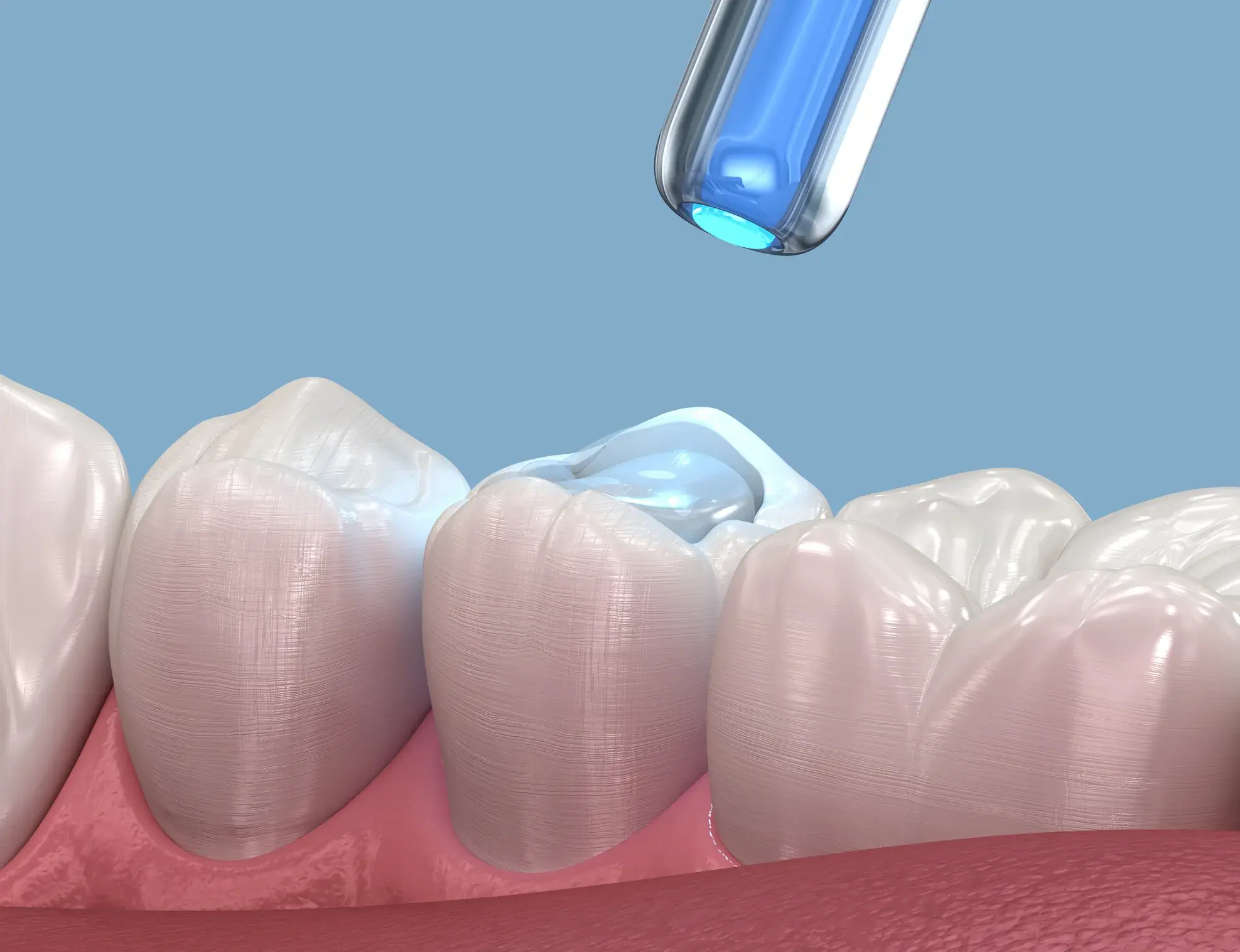
The short answer? Composite resin fillings are tooth-colored fillings that are bonded to your tooth and hardened using a curing light. They are the modern standard, with good longevity and a customizability that allows your dentist to match the shade of your tooth.
In this article, we will go over everything you need to know when it comes to composite resin fillings, from what they’re made of to what they look like to how long they last to how they compare to silver fillings. We’ll then wrap things up by walking through how they’re done here at Noble Dentistry of Chicago in Lakeview.
What Are Composite Resin Fillings?
A composite resin filling is a mix of resin and ultra-fine glass particles that a dentist is able to shape and fit into a cavity, then harden into place with a curing light. While the full name is composite resin filling, you may have also heard it called a resin filling, a tooth-colored composite filling, or just simply a white tooth filling. All of these are names for the same thing.
For a long time, the filling that most dentists used was something called an amalgam filling, better known as a silver filling. It’s a combination of mercury, silver, copper, and tin. However, through technological advances, composite resin fillings came to be. This meant instead of a dark spot on your tooth, a tooth-colored material was able to be bonded directly to your tooth.
To put into perspective just how much of the market has embraced composite resin fillings, a study in 2024 of U.S. health records, published in the Journal of the American Dental Association, found that 21.8% of people who got a filling in a back tooth in 2017 got amalgam. By 2023 that number was down to 4.1%, with the rest getting composite.
What Do Cavity Fillings Look Like?
What a filling looks like depends on the type of filling that you’re getting. A composite resin filling is the color of your tooth, an amalgam filling is a silver color, darkening to gray over time, and a gold filling looks like gold.
What makes composite unique is that it can blend in with the tooth. There is a range of composite shades that a dentist can choose from, so the filling can closely match the coloring of the surrounding tooth. Sometimes composite resin fillings are called white fillings, but the reality is that they aren’t actually white. They’re tooth-colored.
One thing to note before you get a filling is that if you’ve been wanting to whiten your teeth, you should do it before you get the filling, because whitening won’t lighten the filling material. If you whiten first, your dentist can match the shade to your whitened teeth.
How Is a Resin Dental Filling Placed?
A resin dental filling can be placed in one visit. These are the steps you can expect during your visit:
- The tooth is numbed.
- The decay is removed.
- The tooth is etched and coated with a bonding agent that allows the filling to grip the tooth.
- The composite is usually placed in thin layers, and each layer is hardened using a curing light.
- The filling is shaped, the bite is checked, and the surface of the filling is polished.
Moisture can weaken the bond, so during the process, the tooth has to stay dry. The dentist will likely use a tool to vacuum out any saliva and blow air across the surface of the tooth to maintain this dry environment.
How Long Do Composite Resin Fillings Last?
How long a composite resin filling lasts depends on a few different factors, from the size of the filling to the location of the filling to how prone you are to cavities. However, there are studies that have tracked the average lifespan of a filling. A 2024 study published in the Journal of Dentistry that followed more than 700,000 back tooth composite fillings found the median filling lasted 13.3 years before it needed further treatment. When a filling did need work, it was usually simply another filling. This was the case about 63% of the time. However, there were instances when other work needed to be done, with a crown placement needing to happen 16% of the time, and a root canal or an extraction about 10% of the time. The rest of the cases were a mix of less common treatments.
So, let’s unpack what can impact how long your filling lasts.
Size of the Filling
The first factor is the size of the filling. In that same 2024 study that was published in the Journal of Dentistry, it was found that fillings that covered only a single surface of a tooth lasted a median of 14.5 years, while fillings that covered three or more surfaces only lasted 11.4 years.
Location of the Filling
Location is another factor, and in that 2024 study, fillings in premolars lasted a median of 15.7 years, while fillings in molars only lasted 12.2 years.
How Prone You Are to Cavities
The last factor is how prone you are to cavities. In a 2014 review published in the Journal of Dental Research, it was found that fillings in the teeth of people who are at a high risk for cavities ended up failing at 4.6% per year over ten years, while fillings in people who were at a low risk failed at only 1.6% per year.
In both the 2024 and 2014 studies, the main reasons for filling failure were new decay and fracture.
Tooth Filling: Amalgam vs. Composite
Composite is the filling that dentists use most often now, and when you compare amalgam vs. composite side by side it’s easy to see why. Composite resin fillings blend in with your tooth, bond directly to the surface of the tooth, meaning less healthy tooth has to be removed, and the composite doesn’t contain mercury.
One of the most unique characteristics of composite resin is that it can be bonded to the tooth. Traditionally, with amalgam fillings, a cavity is cut out of the tooth in a shape that holds the amalgam in place. This can often require removing more healthy tooth structure than the decay itself has damaged. Meanwhile, the bonding process of composite means only the decayed part of the tooth has to be removed.
Durability is where amalgam has historically had a leg up on composite. However, the American Dental Association says that recent reviews often show composite resin fillings performing as well as amalgam on the durability front, with limited evidence of a significant difference in how long filling materials last.
If you already have an amalgam filling, you might be wondering if the mercury in the filling is bad for you. The Food and Drug Administration (FDA) says that there isn’t conclusive evidence that amalgam harms the general population. However, it does recommend that higher-risk groups, including pregnant women and young children, avoid getting an amalgam filling when possible. It also advises that amalgam fillings that are in good condition shouldn’t be removed unless it’s medically necessary.
Composite Resin Fillings at Noble Dentistry of Chicago
At Noble Dentistry of Chicago, we don’t place amalgam. Our fillings are tooth-colored composite fillings, so you get all of the benefits that we discussed above. In certain cases, Dr. Jared Siegel will use glass ionomer, which is another tooth-colored material.
Dr. Siegel has a conservative-first treatment style, so you’ll never have to worry about getting a filling before it’s needed. In fact, if a cavity is caught early enough, before it’s broken through the enamel, he offers Curodont to hopefully avoid the need for a filling.
If the decay is far enough along that it does require a filling, he’ll walk you through your X-rays, showing you where the decay is, and make sure you understand why the filling is needed.
Noble Dentistry of Chicago is located at 3052 N Lincoln Ave in Lakeview. If you’re in Chicago and think you may have a cavity, or an old filling is bothering you, then book an appointment with us today. Dr. Siegel will show you exactly what he sees and you’ll walk away from the appointment with a clear next step for how to get your oral health back on track.
Sources
- Lamsal R, et al. Declining US dental amalgam restorations in US Food and Drug Administration-identified populations: 2017-2023. Journal of the American Dental Association 2024;155(10):816-824. https://doi.org/10.1016/j.adaj.2024.07.015
- Thyvalikakath T, et al. Survival analysis of posterior composite restorations in National Dental PBRN general dentistry practices. Journal of Dentistry 2024;141:104831. https://pubmed.ncbi.nlm.nih.gov/38190879/
- Opdam NJM, et al. Longevity of posterior composite restorations: a systematic review and meta-analysis. Journal of Dental Research 2014;93(10):943-949. https://pubmed.ncbi.nlm.nih.gov/25048250/
- American Dental Association. Materials for Direct Restorations. Oral Health Topics. Last updated August 16, 2024. https://www.ada.org/resources/ada-library/oral-health-topics/materials-for-direct-restorations
- U.S. Food and Drug Administration. Information for Patients About Dental Amalgam Fillings. Content current as of September 24, 2020. https://www.fda.gov/medical-devices/dental-amalgam-fillings/information-patients-about-dental-amalgam-fillings